

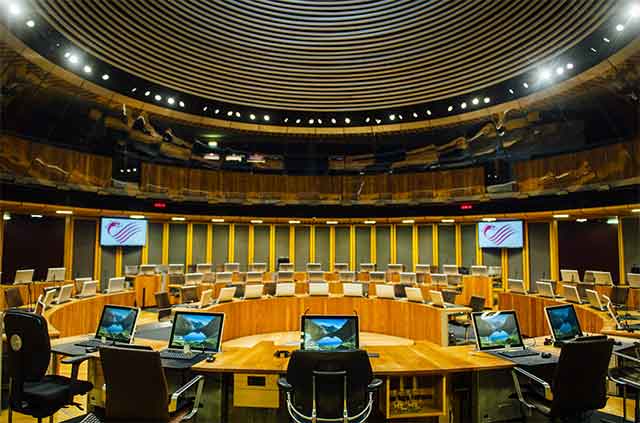
A quarter of Wales’ population remains trapped in an “unacceptable health gap” due to decades of economic stagnation and political failure, a Senedd debate has heard.
The Welsh Government admitted that geography heavily dictates life expectancy in modern Wales, following a short debate highlighting severe health inequalities across the south Wales coalfield.
Around 750,000 people live within former mining areas, which have been slower to recover from the decline of heavy industry than post-industrial regions elsewhere in Britain.
Plaid Cymru MS Matthew Jones, of Sir Fynwy Torfaen, said the need to tackle these inequalities was one of the “main reasons” he stood for election to the Senedd.
Speaking of his own constituency, he said: “Pontypool… and communities across Torfaen are proud places with a strong history and identity. Post-industrial communities like these have yet to fully recover from Thatcher’s de-industrialisation. Austerity has only made this worse.”
Comparing Torfaen and Monmouthshire, Mr Jones highlighted the level of inequality between the neighbouring communities.
He said: “Cancer incidence in the Torfaen coalfield wards is higher than the rest of my constituency. Similarly, chronic conditions are 5% more common in the Torfaen wards.
“Mental health conditions are present in a third of GP cases in the Torfaen wards. Premature deaths and long-term illness are much higher in Torfaen than in Monmouthshire.
“So too are personal independence payment and Universal Credit claimants. This makes the residents in Torfaen much more vulnerable to UK Government benefit changes.”
He continued: “But every statistic represents a person who may be struggling to find work, or a family who may be struggling with the health of one or more of its members, a child going to school hungry.”
He said these comparisons were not meant to diminish the “very real” challenges faced in Monmouthshire but were instead to highlight the inequality felt by former coalfield communities.
Mr Jones added that “health barriers do not stop at the clinic door”, noting the role factors such as transport, housing, food, money, and isolation can play in an individual’s life.
He told the Siambr that people in Blaenavon supported by the Coalfields Regeneration Trust have spoken about how difficult a lack of community transport can make things.
Mr Jones, a former policy and public affairs lead at the Breast Cancer Now charity, asked the Siambr to think about someone going to Velindre Cancer Centre for treatment, which can mean travelling up to five days a week for several weeks.
He said: “If they rely on hospital transport, they can be picked up hours before their appointment and get home hours afterwards. And unless there’s an approved clinical need, they may have to make that journey without a family member or a carer with them.”
He continued: “For someone who is already exhausted, vulnerable and immunosuppressed, that’s not a small thing.
“It affects their wellbeing, their quality of life, and sometimes even the choices they feel able to make about their treatment. This is what inequality looks like in practice.
“Where you live and what transport is available to you can shape your experience of cancer care.”
The former Aberystwyth University tutor also pointed to the role food and money can play in furthering inequalities.
He shared the story of an individual supported by the Coalfields Regeneration Trust, who was helped to secure a Macmillan grant and provided with emergency food support when their household income fell as a result of their diagnosis.
Mr Jones told colleagues that that “kind of practical help” can make a “real difference” to people’s lives, treatment and recovery.
“Long shadow of industrial decline”
Mr Jones also highlighted the economic disadvantages facing the south Wales coalfields.
“More local shops can make it easier for people to get those essentials, and cafes and pubs can all build communities,” he said. “Local enterprise can play a key role in reducing inequalities.”
Pointing to the connection between economic inactivity and poor health, he said: “Lower employment, higher levels of economic inactivity linked to long-term sickness, poorer health outcomes and deeper concentrations of deprivation are not abstract policy terms – they are the lived reality of communities like those in Torfaen and across the south Wales coalfield.
“And, of course, not every challenge faced by former coalfield communities is unique to those communities. Poverty exists in rural Wales, in urban Wales and in communities right across the country, but what we see in the coalfield is a significant concentration of disadvantage, shaped both by present-day deprivation and by the long shadow of industrial decline.”
Focusing on prevention, he added: “If we only intervene at the point of crisis, when somebody’s already ill, already out of work, already in unsuitable housing, or already struggling to cope, then we’re not tackling inequality at its root; we’re simply managing its consequences.”
Fellow Plaid Cymru MS Sera Evans, of Afan Ogwr Rhondda, echoed Mr Jones’ comments and said: “The insecurities of the post-mining economy in south Wales brought new health challenges, compounded by the degeneration of town centres that once fostered association and community, that once housed places that gave people connection and purpose.
“Communities have paid a high price as a result of their loss, reflected in rising levels of isolation and loneliness, […], leading, inevitably, to poorer health outcomes.”
Ms Evans, however, also shared some of the success stories from the south Wales coalfields, noting that her home town Treorchy was recognised as the UK’s High Street of the Year in 2020.
She added: “If we’re serious about tackling health inequalities in our former coalfield communities, then surely we must also be serious about rebuilding the places that bring people together and restoring that culture of communal life that orbited the old industries”.
“Unacceptable health gap”
The deputy minister for public and preventative health, Nerys Evans, said she will “act to bridge the unacceptable health gap that exists”.
Ms Evans acknowledged the need for her government to understand the specific needs of coalfield communities.
She told the Siambr it’s an “uncomfortable fact” that in Wales today, “where a person is born, where they’re brought up and where they live has a deep influence on their health, on their life expectancy and how many years they can expect to live in good health”.
She said: “These communities powered the industrial revolution and fuelled the prosperity of Wales and far beyond. They produced the coal and steel that helped shape modern Britain, and they built strong traditions of solidarity, resilience and community that remain a source of pride today. But our industrial heritage has left a legacy.
“The health inequalities that we see today are the result of long-term social and economic change. They have been shaped by our industrial past and by the decline of the industries on which many families and communities depended.”
Ms Evans added however that these inequalities are the “result of political choices” made by both Westminster and previous Welsh Governments, who she said “failed to give enough priority” to these communities.
The deputy minister said her government is “determined” to address these inequalities and are “committed” to making fairness “the foundation of everything [they] do”.
Ms Evans said she will be setting out her priorities for public and preventative health in the Siambr next week and added: “The challenge before us is not simply to treat illness more effectively, it is to create the conditions across government for better health for all.
“Because good health should never depend on wealth. Because where someone is born should not determine how long they live. And because the gap between the healthiest and the least healthy communities in Wales is not inevitable.”