

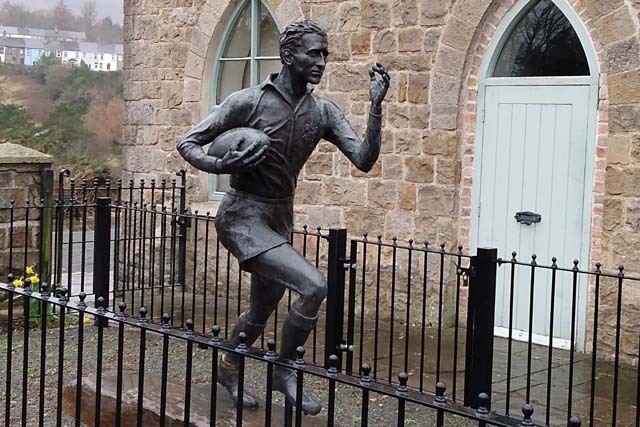
KEN JONES is frozen in time – rugby ball tucked against his chest and secured by his right hand – with his right knee and left arm raised in full flow.
The former Wales rugby international – who sprinted for Great Britain at the 1948 Olympics – is cast in bronze but trapped behind wrought iron railings in a locked garden.
A former British and Irish Lion, who raced to 145 tries in 293 appearances for Newport RFC as well as an Olympic 4x100m silver medal, is probably Blaenavon’s most famous sporting son and, in 2013, was commemorated with the statue intended to take pride of place on a corner spot off Broad Street, the town’s main high street.
But just less than 10 years later it had to be removed due to vandalism while wrangling over ownership saw Ken hidden away in storage for two years before a new, more secure, spot was found outside the town’s World Heritage Centre.
The plight of this local hero perhaps indicative of some of the ills that blight his hometown; petty vandalism, boredom and even a centre built to cater for its status a World Heritage Site centre closed on Mondays without sufficient footfall to justify seven day a week opening. Official figures place Blaenavon at the wrong end of the league table of Wales’ most deprived areas.
Blaenavon’s World Heritage status, also held by destinations and historical sites as famous as Australia’s Great Barrier Reef, the Great Wall of China and Italy’s Mount Etna, was awarded by United Nations cultural body UNESCO, in 2000 in recognition of its contribution to the iron and coal industries.
This year marks the official 25th anniversary and while some question what the international recognition has achieved a new title is already being eyed up.
Blaenavon, population 6,000, is considering a bid to be named the UK’s Town of Culture, for 2028, which carries a £3m prize fund, from the UK Government, to stage a series of events to inspire people to take part in cultural activity.
“People feel proud of the World Heritage status but it could well be some people feel it’s not delivered all it could have,” conceded Nathan Matthews the councillor spearheading the town council’s potential bid: “The status was never a panacea for all Blaenavon’s problems which are structural and similar to many post industrial communities.
“I think the Town of Culture can help build on that and be the next step.”
The UK Government hopes naming a town of culture will replicate the success of the City of Culture initiative held by Bradford last year and Hull in 2017 among others.
Ian Haywood, a Blaenavon resident for eight years, is originally from Batley, near the Yorkshire city and said: “Hull had it and it was a great benefit and I followed it all year round it had things such as shining lasers from buildings in a deprived area.”
The former cookery teacher said there are “various groups” in the area which “keep people occupied” but said he’s had more involvement in Blaenau Gwent where he was behind a campaign for a monument honouring Brynmawr-raised Rugby League coach Roy Francis.
“Though I live in Blaenavon I’m more involved in Brynmawr. I was responsible for the Roy Francis monument. He coached Hull FC which made him the first black coach in any professional club in Britain and he also lived in Batley. I approached Brynmawr RFC and Blaenau Gwent council and they were great and enthusiastic about it.”
Big Pit set Blaenavon on the path to exploiting the potential for heritage tourism. It closed as a working mine in 1980 and within a few short years became a museum taking visitors underground, later coming under the fold of National Museum Wales.
World Heritage Status, and subsequent grants, have pumped between £40 to £50 million into Blaenavon over the past 25 years, most notably in restoring its many old buildings, said Cllr Matthews who added stepping up cultural activities would be an extension of support for the town’s environment.
Its natural environment, the coal, limestone and iron ore that fuelled the industrial revolution, and the structures from the imposing ironworks and its giant blast furnaces to chapels built as a result of the industrial and population boom remain intact.
“They sit together in one connected setting,” is how Cllr Matthews put it: “What makes Blaenavon distinctive is that its entire cultural landscape remains legible.”
Town of Culture status could take that further “There are creative people setting up in Blaenavon and young people say they want more culture opportunities as they say there’s not a lot for people who don’t want to do sport, they want more arts and cultural provision and there is an opportunity for that up skilling.”
For 20-year-old Amelia Madley the main question around the cultural title is “what would it actually mean, what would happen to the town?”
The pharmacy worker said other than the annual World Heritage Day, held in the summer, “there’s not much going on here”. She also wants to see activities for younger people: “It would be nice to get something for the teenagers as they must be bored. When I was a teenager we would just go out and find somewhere warmer and we’d sit there for hours on end.”
As for the town as a tourist attraction, she thinks most of the 150,000 people that visit Big Pit every year “go to Abergavenny after that.”
At the attraction, which is fully booked for its underground tours on a wet Monday helped by at least two coachloads of primary school children, the view visitors don’t make the one-mile journey to the town centre appears to be confirmed.
Friends ‘Tia’, and Jeanie Hoyle, both 20 and from Blackwood, have come as, Tia put it: “Jeanie’s never been, so I made her come.”
First-time visitor Jeanie explained she had only moved to the UK after primary school so missed out on what her friend and guide described as “a standard school trip”.
But ‘Tia’ is no help on leading an expedition to Blaenavon: “I don’t even know what is in the town.”
Philip Wagget, from Abergavenny, is showing relatives Dagmar Relling, and her son Cody, from Vancouver, around various local sites. Big Pit followed a Sunday outing to Raglan Castle.
“It’s my first time in Wales,” said Canadian Ms Relling: “The history is super fascinating for us. In Vancouver we have a different history. We don’t have the castles I’m blown away by it.”
Her Welsh relative has a personal connection with Big Pit as his Uncle Ray worked there while it still produced coal: “He was an overman and he went down at 13 and came up at 65.”
Mr Wagget thought the last time he visited Blaenavon town was for Uncle Ray’s funeral but corrected himself when he remembered attending a concert by Blaenavon Male Voice Choir at the Workmen’s Hall.
In the town Gerry Woodhouse is one of those to have benefited from the heritage status when in December 2006 he and his wife established their Blaenafon Cheddar artisan cheese company that has since expanded to two shops on Broad Street.
“The heritage status helps in a lot of ways but we haven’t seen the growth I think they were hoping for,” said the cheesemaker but while he said his wife is likely to have a better knowledge of the details of a town of culture bid said: “Any recognition is good.”
He credited nearly 20 years on the high street to “good, regular customers” but acknowledged footfall is challenging but praised the town council and other authorities for supporting events.
Opposite the cheese shop is the Welsh General Store.
“Lots of people come in expecting just a coffee shop but are really pleased and surprised with the range of stuff we do, it’s nice to see people are shocked by it. Everything is Welsh,” said Meg Davies who was working behind the counter and highlighted stock from tea, biscuits and preserves to cards made by local artists.
The shop assistant, who lives in Abertillery, said Blaenavon has “potential to be a really busy town but nothing last up here as people don’t have the money to put into businesses, they don’t have the money to spend.”
Welsh General Store received a boost when “Welsh menopausal girlies” Leigh and Emma, who have more than 5,000 Facebook followers filmed a video highlighting the shop.
“Literally within a week we had 20 to 30 people pop in saying it was from seeing their video,” said Ms Davies who also described Tuesdays as a busy day “as there’s lot of activities going on in town and people come in after. There’s a sewing and a stitching group that meet in the church at the bottom of the hill.”
Blaenavon Town Council will consider a report and whether to submit a formal bid for Town of Culture status when it meets on Wednesday, March 25.