

The new Welsh Government has unveiled its first supplementary budget for 2026/27.
A supplementary budget allows in-year adjustments and new spending allocations to the Welsh Government’s previously agreed budget.
The supplementary budget was announced by Wales’ finance minister, Elin Jones on Tuesday 23 June.
It focused on extra funding for the NHS and tackling child poverty – pledging a total of £294 million in extra funding to fulfil Plaid Cymru’s election promises.
The budget includes a £145 million investment into the health service, an extra £55 million to “make early headway” on Plaid Cymru’s childcare offer, and £8 million to safeguard the £1 bus fares for children and young people.
Pledging to “press for fairness” throughout her dealings with the UK Government, Ms Jones said she raised the issue of fiscal reform for Wales, including historic and future rail funding, with the UK Government,
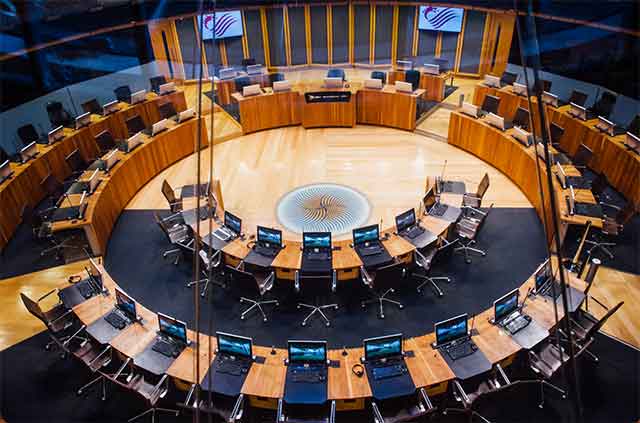
Ending her speech to the Siambr, Ms Jones said: “I present this budget today, yes, in the name of Plaid Cymru, but also as a budget that can work for this Senedd as a whole, because it’s a budget that works for Wales as a whole.”
“Serious concerns”
However, the cabinet minister came under significant scrutiny over funding to support children with additional learning needs (ALN).
Ms Jones faced questions on why the Plaid Cymru government was not providing local authorities with the ALN funding allocated by the Labour-run UK Government.
Ms Jones said: “The consequential funding to the budget from the write-off of local government’s special educational needs debts in England, together with the reserves at the beginning of a financial year, allow this government to earmark additional funding today while keeping an eye on the ongoing financial pressures that continue within our public sector.”
Reform’s shadow finance minister, Cai Parry-Jones, said it appeared as though “a substantial sum of this money, if not all the money, has been diverted to other projects.”
Mr Parry-Jones told the Siambr that both Audit Wales and the Welsh Local Government Association (WLGA) have “serious concerns” about the “financial sustainability of ALN in Wales”.
He said: “The money Westminster has provided for this purpose is not just needed to improve the education of our most vulnerable children, it’s essential to keep the system they rely on afloat.”
The shadow minister added: “As if that wasn’t enough evidence that diverting ALN funding is a mistake, the National Association of Head Teachers have recently come out and said that, as a result of this move, children with ALN in Wales will be worse off than those in England.”
In response, Ms Jones told colleagues the money allocated to the Welsh Government occurred as a result of a debt write-off for local authorities in England on ALN provision.
She said: “It is, as I said, not being seen as a way of providing a one-off contribution to local authorities as a result of that debt write-off; those debts have not existed or been allowed to exist in Wales in the same way as they have been in England.
England
“No extra provision in England will happen for additional learning needs as a result of the allocation in England.
“And therefore I think what this discussion on the consequential has resulted in is that it’s brought us as a Government into early focus on the pressures on ALN budgets in Wales.”
The cabinet minister said her government is “not in the business of one-off quick fixes; we are in the business of planning for a proper, sustainable footing for additional learning needs in Wales”.
Ms Jones said the annual budget discussions she will have with the ministers for education and local government will result in a “far more comprehensive assessment” of what is needed regarding ALN funding.
Labour’s democracy spokesperson, Huw Thomas, also quizzed the minister and said: “Our additional learning needs system is under pressure. Children and young people’s needs require more complex, extensive and long-term support.
“The pressure facing England exists here in Wales too. And just because Welsh councils have been better funded and better managed than some of those in England that have had to resort to a statutory override, it does not mean that school reserves have sufficient headroom to absorb ongoing cost increases.
“Every single Welsh council, of every political stripe, including Plaid Cymru ones, every teaching union, has called on this government for this money to go to schools.”
Responding to the Labour MS, Ms Jones reiterated that money provided in England is to write off debts accrued by the councils in providing ALN services – not money to be used for providing more ALN services.
She said: “We need to get on top of ALN expenditure. It has grown 2.5 times faster than overall educational spend in the last ten years, and it is on a trajectory to reach a £1 billion spend within a few years.
“But this issue is best dealt with on a sustainable, recurrent basis, and properly planned for, and that is the work that I am going to be doing in the context of the annual budget with the minister for education.”
ALN debts
Sam Rowlands, who is the Conservative spokesperson for education and families, questioned the minister on her claim that Welsh schools do not face the same ALN debts as their English counterparts.
He said: “Most of those debts won’t show as an ALN debt on a budget ledger. They are the reason, often, why so many schools in Wales now are running deficit budgets.
“Schools in Wales are running tens of millions of pounds in deficit budgets. That is the very real debt that education and schools are in, and ALN is a significant proportion of that.
“That has to be recognised, cabinet minister. I’m not sure what your officials are telling you if you think that that debt does not exist here in Wales. It definitely does, and it needs to be addressed.”
Ms Jones responded: “We do know that there are deficits that are held by schools, by more schools now than it used to be.
“The figures that I have show that 27% of schools in Wales have a deficit, and we can also know that some of that deficit is created as a result of the pressures on ALN, but not exclusively ALN; there are other pressures that schools have faced as well.
“Therefore, these issues are ones that we will want to investigate as we move on now to think about how we ensure that schools are able to budget in a way that enables ALN to be delivered effectively in the school setting and beyond”.
“Borrowing powers”
Welsh Liberal Democrats leader, Jane Dodds, said she was “looking forward” to hearing more about the Cynnal payment – Plaid’s proposed child payment for households on universal credit.
She said: “We know that in Scotland, 100,000 children have been lifted out of child poverty due to their child payment. We know that 40% of nought to four-year-olds here in Wales are living in poverty, so I am really pleased to see that some action is going to be taken there.
“But we know that poverty is linked to other things. It’s not just about a payment – it’s about housing, it’s about infrastructure as well. Wales surely needs to look at its borrowing powers.”
Ms Dodds pressed the minister to share how she will be moving forward with regards to Welsh Government borrowing powers.
Ms Jones said: “A great number of powers that are already in place in Scotland aren’t available in terms of our budgetary purposes today.
“So, the discussion that I started with the chief secretary to the treasury, when I met her, on the need to tackle many of these issues – which aren’t huge devolved issues, they are easy to identify and there is specific value in delivering them – will continue with the UK Government.”
Seemingly referring to the resignation of Prime Minister Sir Keir Starmer, Ms Jones added: “Who knows, maybe the events of the last few days will lead to better outcomes than what we’ve seen over recent years?”